
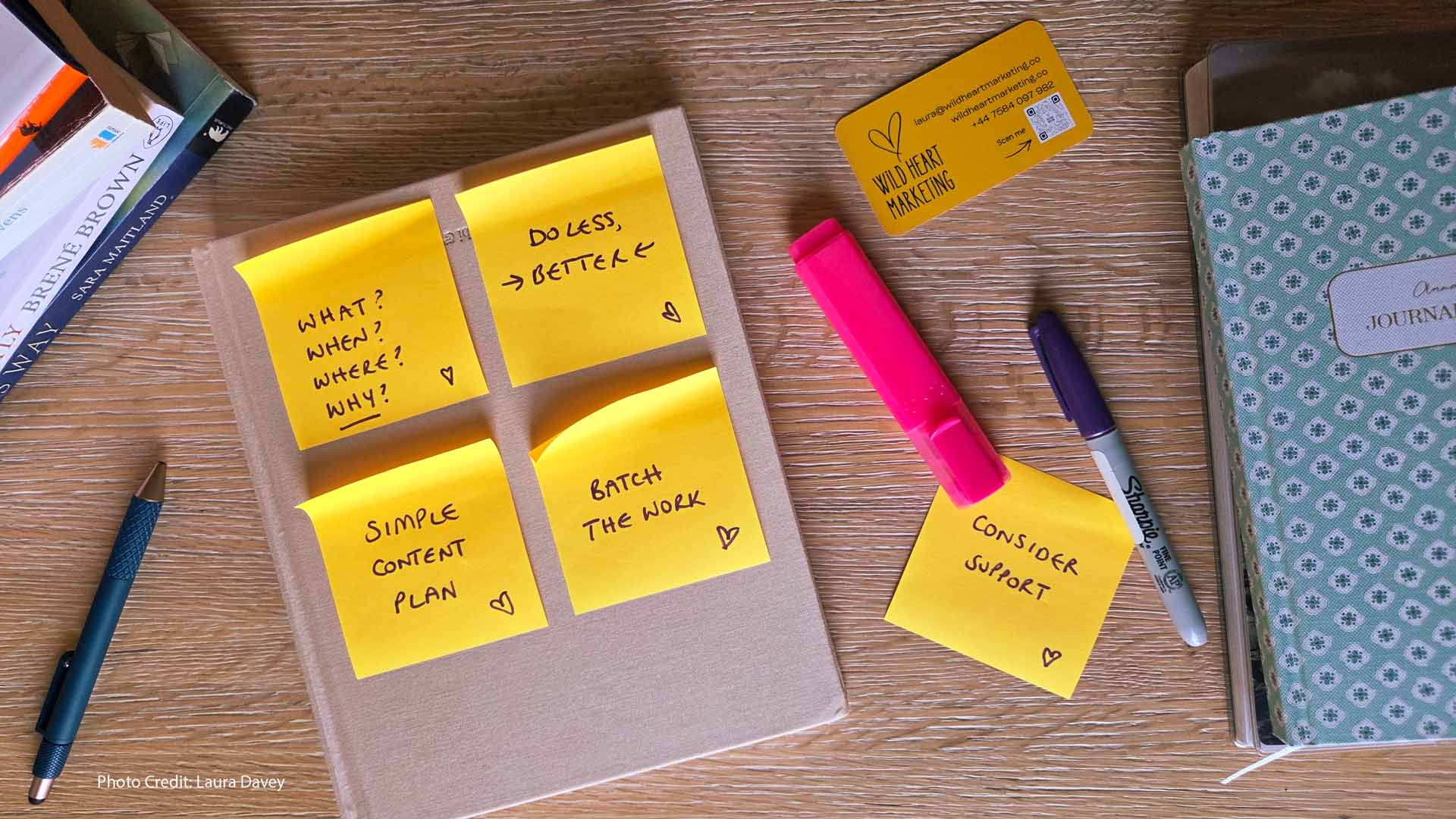
If your marketing is the thing that keeps slipping down your list of priorities, the thing that’s always on the list but never quite gets done – you’re not alone. It happens a lot, and it has some very specific causes.
I’ve worked in marketing for over 20 years and in that time, one thing I’ve seen consistently is this: the organisations doing the most important work are often the ones who struggle most at talking about it.
That’s not meant to sound critical. It’s an observation about what happens when the mission is the priority (as it absolutely should be!) and marketing becomes the thing that gets whatever’s left over.
The result is inconsistency. Bursts of activity followed by silence. Content that starts strong and then just…stops. Social media profiles that haven’t been updated in six months. Email newsletters that were going to be monthly and are now quarterly at best.
Does that sound familiar? If so, this is for you.
Why it happens…
There are usually a few things going on at once.
Everything else is more urgent
In a small, purpose-driven organisation, there’s always something more pressing than writing a LinkedIn post; a funding deadline, a delivery challenge, a staffing issue, a brilliant opportunity that needs a proposal by Friday.
Marketing rarely has a deadline in the same way. So it waits, and suddenly a month has passed and you realise you’ve barely shown up anywhere.
Marketing doesn’t feel like the real work
For people who got into conservation, sustainable travel, social enterprise, or any of the other sectors I work with – marketing can feel like a distraction from the actual job. The actual job is protecting the habitat, running the programme, making the product, serving the community.
This is completely understandable, but it can be costly. Without visibility, even the best work stays invisible.
It requires a different kind of thinking
The skills that make someone excellent at conservation work, community development, or ethical food production, aren’t the same skills that make someone good at marketing. Both are learnable, but trying to switch between them repeatedly, in the gaps between everything else, is really hard.
There’s no system holding it together
Often inconsistency is down to a lack of systems. When there’s no clear plan for what to post, when, where, and why – everything depends on someone having the headspace to think it through from scratch, each time. And realistically, how often is that headspace available?
What actually helps…
There’s no magic fix, but there are things that make a real difference.
Reducing the scope
Most small organisations are trying to be on too many platforms, doing too many things. The first step to consistency is usually doing less! Choose fewer channels and commit to posting and engaging there regularly, rather than trying to be everywhere ad hoc.
One channel, done well and done consistently, will almost always outperform five channels done sporadically. Pick the one where your audience actually is, and focus your efforts there.
Having a plan (a simple one is fine)
A content plan doesn’t have to be complex. It could be as simple as: one LinkedIn post per week, one newsletter per month, and four topics to rotate between. That’s enough structure to take the decision-making out of it, which is where a lot of energy often gets lost.
Batching the thinking
Rather than trying to come up with content ideas when it comes to mind, dedicate a specific time. Whatever frequency works; monthly, quarterly (it will vary depending on your specific business). Use to this regular timeslot to map out what you’re going to say and when. This way the execution part becomes a much simpler task.
Getting some support
Sometimes the most effective thing is having someone outside the organisation to think things through with. Not to take over (although that can sometimes be a huge help too!), but to help with the planning, the prioritisation, and the accountability that keeps things moving when everything else is competing for attention.
This is what many of my clients find most useful about working together – not the deliverables, but having someone to keep them on track.
The thing to remember…
Consistency doesn’t mean posting every single day or having a perfectly curated feed. It means communicating and engaging regularly enough that the people you’re trying to reach know you’re there, and know what you stand for.
For a purpose-driven organisation, that consistency is especially important. The work you’re doing matters, and the people who need to know about it deserve to find you.
If consistency is the thing you’re struggling with most, the Wild Heart Partner might be worth a look. It’s ongoing support; having someone in your corner regularly, helping you stay on track without taking over. Have a look at the services page, or just get in touch for a no-obligation conversation.
FREQUENTLY ASKED QUESTIONS
Q: Why do small charities and social enterprises struggle with marketing?
A: Usually a combination of limited resources, competing priorities, and the fact that marketing requires a different kind of thinking from the core work. Add the absence of a clear plan or system, and inconsistency becomes almost inevitable. The good news is that even small changes to structure and scope can make a massive difference.
Q: How often should a small purpose-driven organisation post on social media?
A: Consistently is more important than frequently. It’s better to post twice a week every week than five times one week and nothing for the next three. The right frequency depends on your audience, your platform and your capacity but in most cases, once or twice a week on a single well-chosen platform is a strong starting point.
Q: How do I create a simple content plan for my organisation?
A: Start with three things: who you’re trying to reach, what you want them to understand or do, and where they actually spend their time online. Then map out a small number of topics you’ll rotate between e.g. your work in action, your values and mission, practical information that’s useful to your audience, and behind-the-scenes of the people and places involved. Build a simple calendar showing when each piece goes out. Keep it achievable.
Q: Is it worth hiring a marketing consultant for a small charity or social enterprise?
A: It depends on what you need. If you have a clear strategy but struggle with execution, you might need systems rather than consultancy. If you’re unclear on direction, audience or messaging, outside thinking can be really valuable. The most useful thing a consultant can often do for a small organisation is help them focus; do fewer things better, with a clear sense of why.